
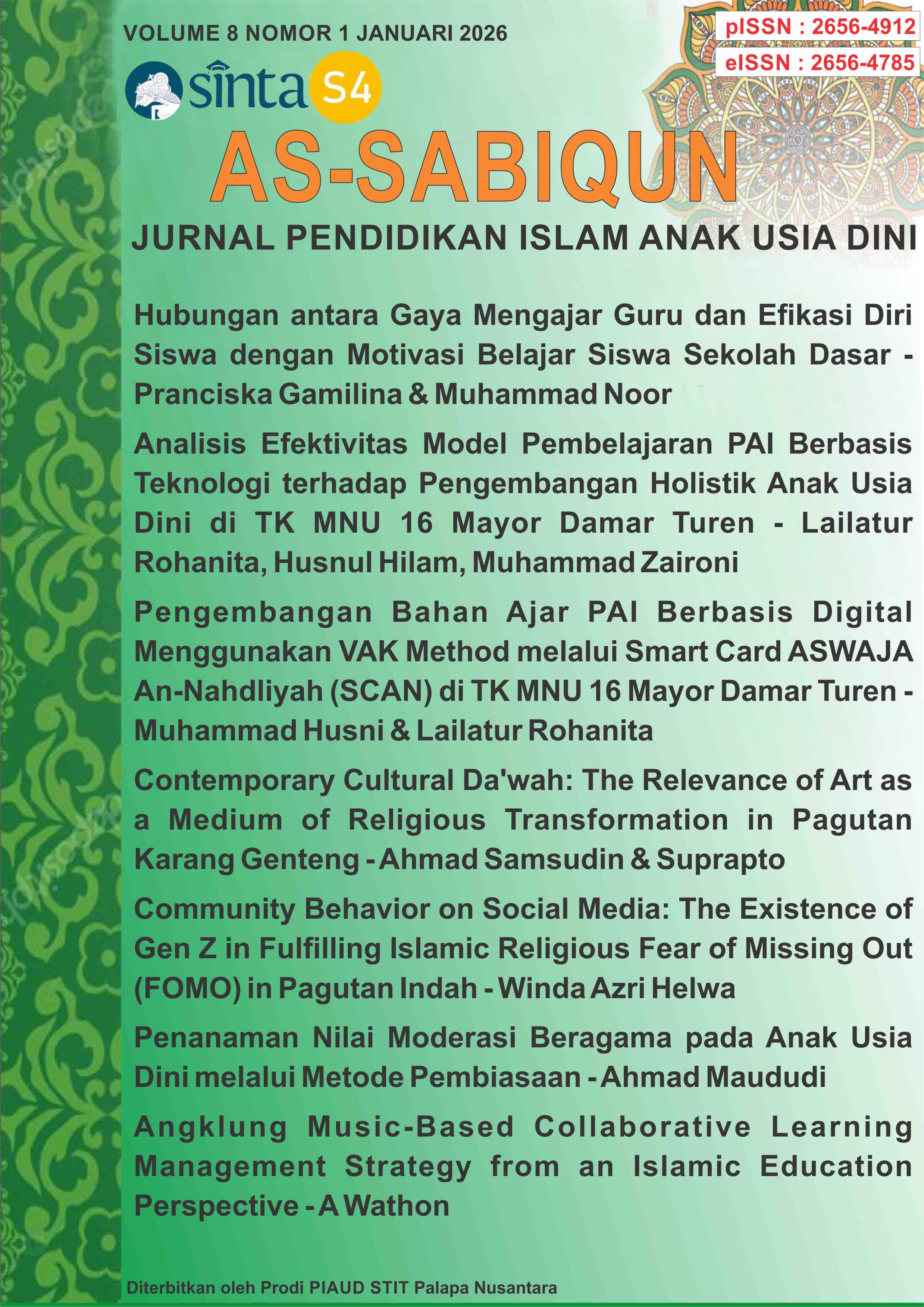
Analisis Efektivitas Model Pembelajaran PAI Berbasis Teknologi terhadap Pengembangan Holistik Anak Usia Dini di TK MNU 16 Mayor Damar Turen

Article Sidebar
 Digital Object Identifier:
10.36088/assabiqun.v8i1.5976
Digital Object Identifier:
10.36088/assabiqun.v8i1.5976
 Viewed : 426 times
 Downloaded : 576 times
















Main Article Content
1 Universitas Al-Qolam Malang, 2 Universitas Al-Qolam Malang, 3 Universitas Al-Qolam Malang
Abstract
The integration of technology into Islamic Religious Education (PAI) for early childhood is an urgent necessity amid changes in the educational ecosystem in the digital era; however, its implementation still faces challenges in maintaining alignment between technological innovation, Islamic values, and children’s developmental characteristics. This study aims to analyze the effectiveness of a technology-based PAI learning model adapted to the context of an Aswaja An-Nahdliyah-oriented institution at TK Muslimat NU 16 Mayor Damar Turen, particularly in supporting the holistic development of students. Employing a descriptive qualitative approach with a case study design, data were collected through observation, in-depth interviews, documentation, and field notes, and were subsequently analyzed using the Miles and Huberman model. The findings show that the use of digital media, such as interactive videos, Islamic applications, digital storytelling, animations of the stories of the prophets, Smart Hafiz, and Smart Card Aswaja, has a positive impact on children’s cognitive, affective, and psychomotor development; children are better able to understand basic Islamic concepts, display emotional responses consistent with the moral values of the stories, and imitate worship movements more accurately. Nevertheless, the implementation of this model is not yet fully optimal due to limited devices, varying levels of teachers’ digital literacy, and the high potential for visual distraction among children. This study concludes that the technology-based PAI learning model is effective as long as it is curated through a pedagogical approach that is sensitive to Islamic values and children’s developmental stages. The implications are that educational institutions need to strengthen teachers’ religious digital literacy, enhance technological infrastructure, and develop developmentally appropriate PAI media so that technology integration proceeds in a sustainable and transformative manner.
Citation Metrics:


Downloads
Article Details

Authors retain copyright and grant the journal right of first publication with the work simultaneously licensed under a Creative Commons Attribution-NonCommercial-ShareAlike 4.0 International License that allows others to share the work with an acknowledgement of the work's authorship and initial publication in this journal.
Find the perfect home for your research! If this journal isn't the right fit, don't worry—we offer a wide range of journals covering diverse fields of study. Explore our other journals to discover the ideal platform for your work and maximize its impact. Browse now and take the next step in publishing your research:
| HOME | Yasin | AlSys | Anwarul | Masaliq | Arzusin | Tsaqofah | Ahkam | AlDyas | Mikailalsys | Edumalsys | Alsystech | AJSTEA | AJECEE | AJISD | IJHESS | IJEMT | IJECS | MJMS | MJAEI | AMJSAI | AJBMBR | AJSTM | AJCMPR | AJMSPHR | KIJST | KIJEIT | KIJAHRS |