
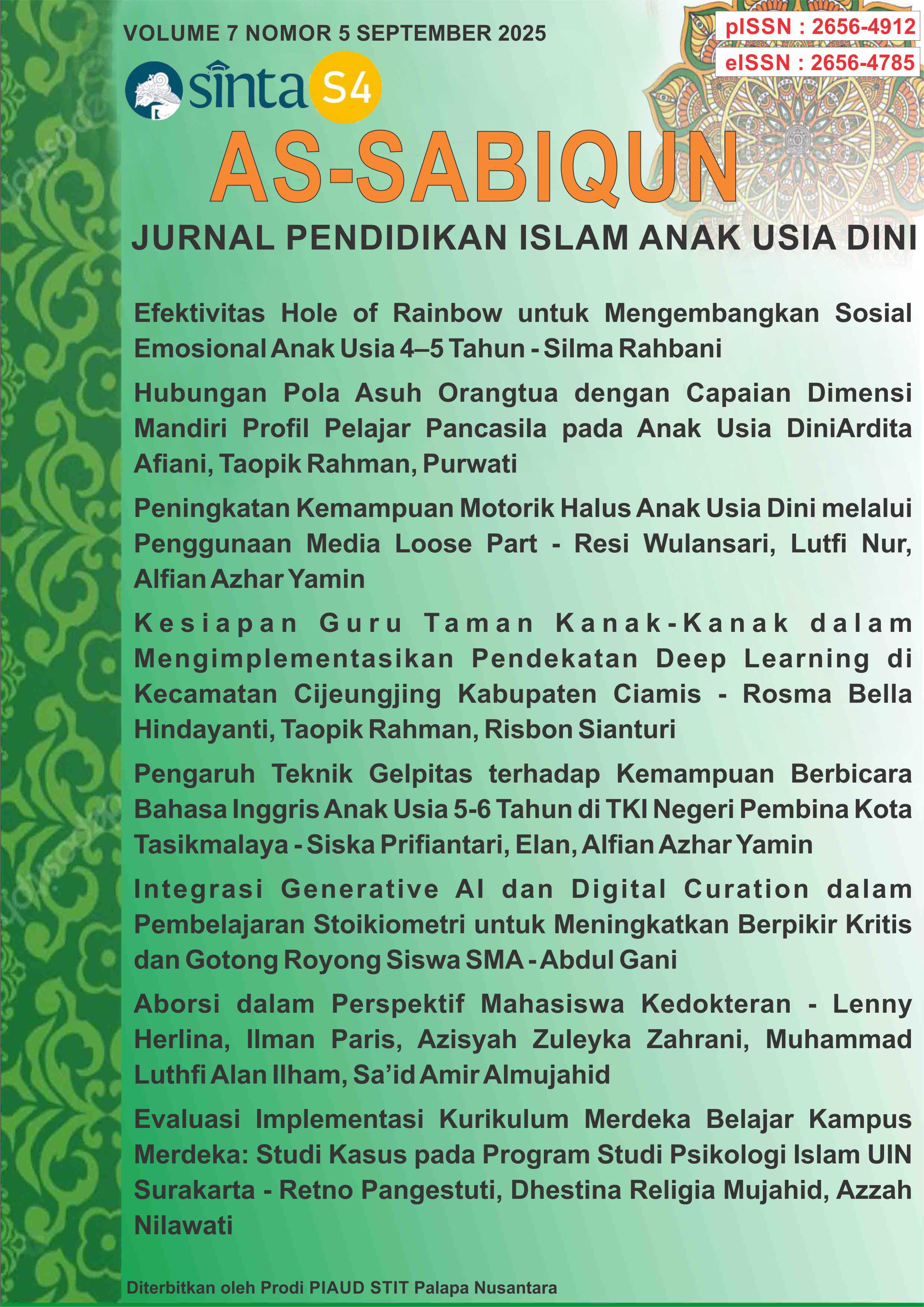
Evaluasi Implementasi Kurikulum Merdeka Belajar Kampus Merdeka: Studi Kasus pada Program Studi Psikologi Islam UIN Surakarta

Article Sidebar
 Digital Object Identifier:
10.36088/assabiqun.v7i5.5905
Digital Object Identifier:
10.36088/assabiqun.v7i5.5905
 Viewed : 444 times
 Downloaded : 473 times
















Main Article Content
1 UIN Raden Mas Said Surakarta, 2 UIN Raden Mas Said Surakarta, 3 UIN Raden Mas Said Surakarta
Abstract
The limited number of studies evaluating the Merdeka Belajar Kampus Merdeka (MBKM) curriculum in Islamic Psychology programs forms the background of this research, despite its crucial role in ensuring the sustainability, effectiveness, and quality of MBKM implementation in religious higher education institutions. The purpose of this study is to evaluate the implementation of the MBKM curriculum in the Islamic Psychology Study Program, Faculty of Ushuluddin and Da’wah, UIN Raden Mas Said Surakarta, using the CIPP model (Context, Input, Process, Product). A qualitative case study approach was employed with six purposively selected participants. Data were collected through interviews and documentation, analyzed using Atlas.ti 8, with data reliability tested through source triangulation and double coding, yielding a Krippendorff’s Alpha value of 0.979, which indicates very high reliability. The results show that in terms of context, MBKM is relevant to student competency development; in terms of input, the program expands access to learning experiences but still faces obstacles in socialization and infrastructure, including the ‘Merpati’ application system. In the process dimension, internship and student exchange activities provide significant benefits but remain constrained by course conversion and differences in academic culture. In terms of product, MBKM contributes to enhancing students’ skills, although learning outcomes are not yet evenly distributed. The study concludes that the implementation of MBKM in the Islamic Psychology Study Program has had a positive impact, but requires continuous improvement in socialization, academic administration, and technological system utilization. The theoretical implication of this research enriches the literature on MBKM evaluation in the context of Islamic Psychology, while the practical implication provides a basis for recommendations to study program managers in formulating adaptive and contextually relevant strategies for improving MBKM implementation.
Citation Metrics:


Downloads
Article Details

Authors retain copyright and grant the journal right of first publication with the work simultaneously licensed under a Creative Commons Attribution-NonCommercial-ShareAlike 4.0 International License that allows others to share the work with an acknowledgement of the work's authorship and initial publication in this journal.
Find the perfect home for your research! If this journal isn't the right fit, don't worry—we offer a wide range of journals covering diverse fields of study. Explore our other journals to discover the ideal platform for your work and maximize its impact. Browse now and take the next step in publishing your research:
| HOME | Yasin | AlSys | Anwarul | Masaliq | Arzusin | Tsaqofah | Ahkam | AlDyas | Mikailalsys | Edumalsys | Alsystech | AJSTEA | AJECEE | AJISD | IJHESS | IJEMT | IJECS | MJMS | MJAEI | AMJSAI | AJBMBR | AJSTM | AJCMPR | AJMSPHR | KIJST | KIJEIT | KIJAHRS |