
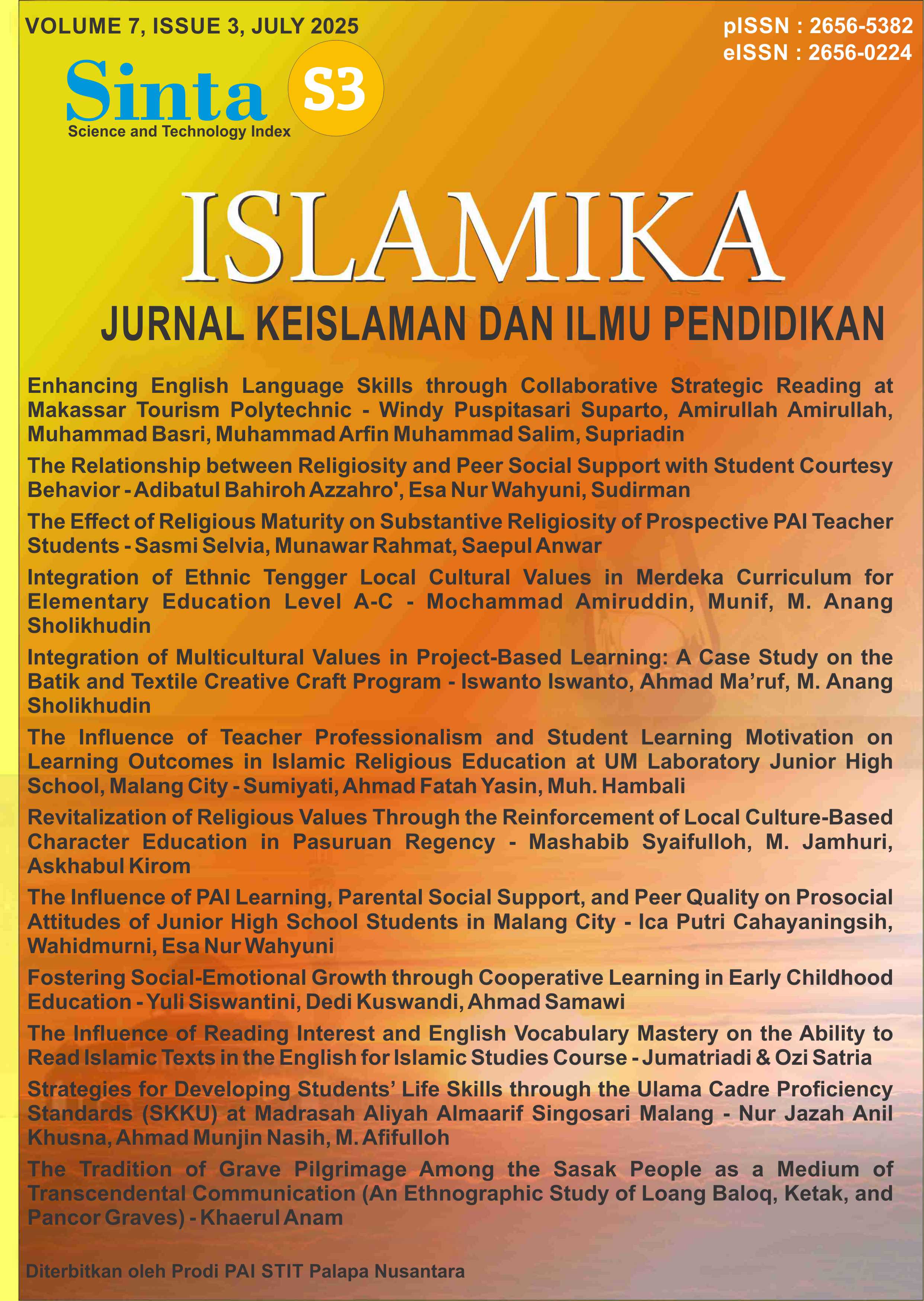
The Tradition of Grave Pilgrimage Among the Sasak People as a Medium of Transcendental Communication (An Ethnographic Study of Loang Baloq, Ketak, and Pancor Graves)

Article Sidebar
 Digital Object Identifier:
10.36088/islamika.v7i3.5816
Digital Object Identifier:
10.36088/islamika.v7i3.5816
 Viewed : 562 times
 Downloaded : 468 times
















Main Article Content
1 Universitas Islam Negeri Mataram, Indonesia
Abstract
This study was driven by the limited scholarly attention given to grave pilgrimage as a medium of transcendental communication, despite its vital role in preserving spiritual and cultural life. Focusing on the Sasak community of Lombok, the research explored how transcendental communication is conceptualized and enacted through grave pilgrimage at three sacred sites: Loang Baloq, Ketak, and Pancor. The study examined the spiritual, cultural, and social motivations behind these practices, as well as the role of ritual expressions and the Sasak language in facilitating a deeper divine connection. Employing a qualitative ethnographic design, data were collected from 25 informants, including grave custodians, long-term pilgrims, and religious leaders selected through purposive and snowball sampling. Data collection methods included participant observation, semi-structured interviews, and documentation, with thematic analysis conducted using the Miles, Huberman, and Saldaña model. Triangulation and member checking ensured validity. Findings revealed that grave pilgrimage among the Sasak serves as a wasilah (spiritual medium) through which individuals seek proximity to Allah by invoking the presence of pious ancestors. The use of the Sasak language in ritual acts such as dhikr, du’a, Qur’anic recitation, and Hizib Nahdlatul Wathan enhanced emotional and spiritual engagement. Motivations for pilgrimage included hajat (spiritual petitions), contemplation of mortality, and the intergenerational transmission of religious and cultural values. The study concludes that Sasak grave pilgrimage represents a syncretic practice that integrates Islamic teachings with local cultural heritage. It offers theoretical contributions to the field of religious communication and practical insights for cultural preservation, spiritual tourism, and interfaith dialogue.
Citation Metrics:


Downloads
Article Details

Authors retain copyright and grant the journal right of first publication with the work simultaneously licensed under a Creative Commons Attribution-NonCommercial-ShareAlike 4.0 International License that allows others to share the work with an acknowledgement of the work's authorship and initial publication in this journal.
Find the perfect home for your research! If this journal isn't the right fit, don't worry—we offer a wide range of journals covering diverse fields of study. Explore our other journals to discover the ideal platform for your work and maximize its impact. Browse now and take the next step in publishing your research:
| HOME | Yasin | AlSys | Anwarul | Masaliq | Arzusin | Tsaqofah | Ahkam | AlDyas | Mikailalsys | Edumalsys | Alsystech | AJSTEA | AJECEE | AJISD | IJHESS | IJEMT | IJECS | MJMS | MJAEI | AMJSAI | AJBMBR | AJSTM | AJCMPR | AJMSPHR | KIJST | KIJEIT | KIJAHRS |