
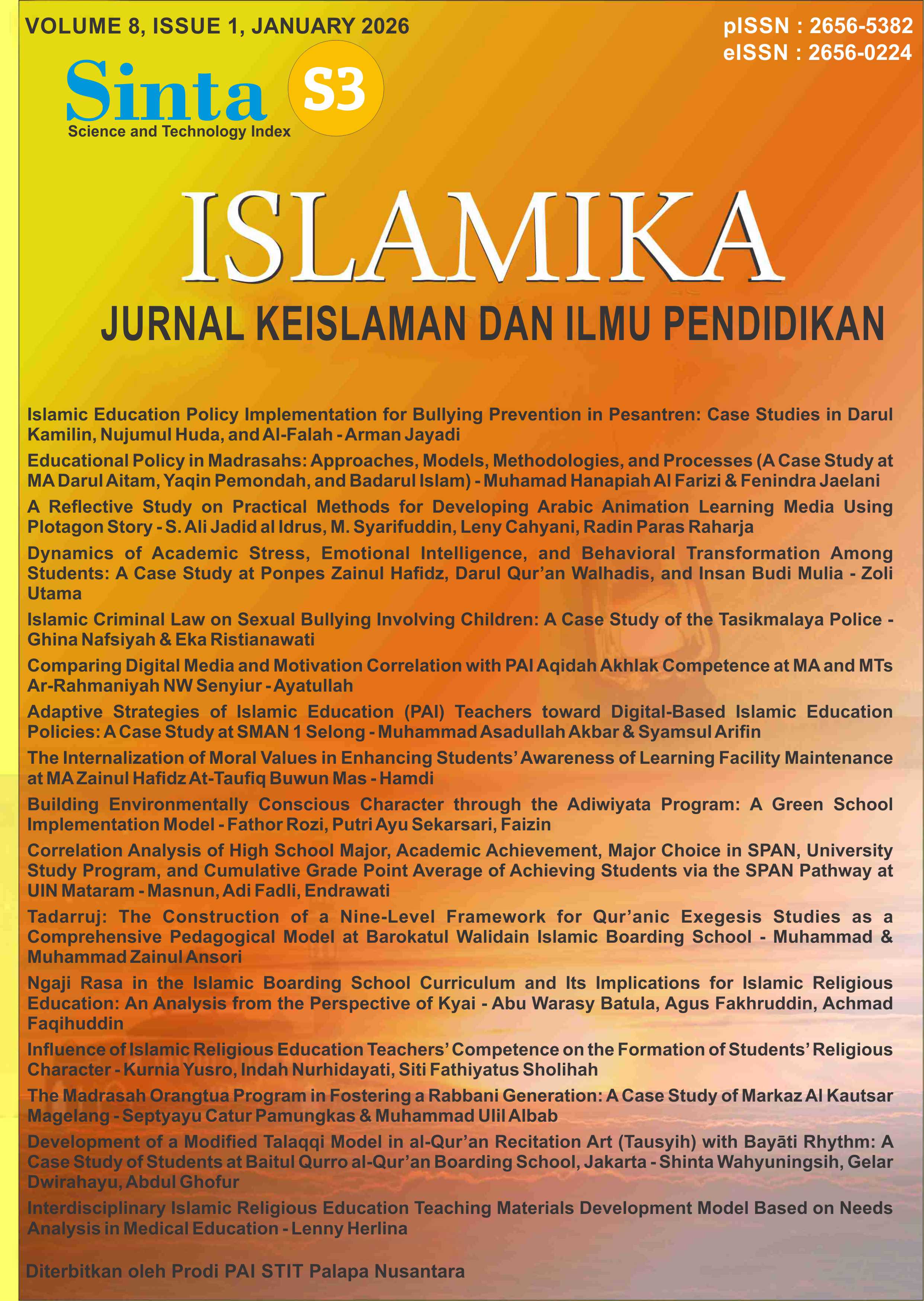
Interdisciplinary Islamic Religious Education Teaching Materials Development Model Based on Needs Analysis in Medical Education

Article Sidebar
 Digital Object Identifier:
10.36088/islamika.v8i1.6102
Digital Object Identifier:
10.36088/islamika.v8i1.6102
 Viewed : 276 times
 Downloaded : 238 times














Main Article Content
1 University of Mataram, Indonesia
Abstract
The transformation of twenty-first-century medical education demands the systematic integration of clinical competence, moral integrity, and social sensitivity; however, the implementation of Islamic Religious Education (PAI) in many universities remains predominantly normative–doctrinal and insufficiently aligned with the professional needs of medical students. This study aims to develop an interdisciplinary model of PAI teaching materials with a focus on religious moderation, based on a comprehensive needs analysis in medical education. Adopting a research and development (R&D) approach, the study was conducted in the Medical Education Program, Faculty of Medicine and Health Sciences, University of Mataram. The needs analysis was implemented in multiple stages through document review of existing teaching materials, classroom observations, interviews with policymakers and lecturers, and questionnaires administered to 32 students. Qualitative data were analyzed thematically, while quantitative data were processed using descriptive statistics. The findings reveal structural and substantive gaps in the previous teaching materials, particularly in professional relevance, integration of religious moderation values, and alignment between learning outcomes and learning strategies. Students also indicated a need for reinforcement at the levels of conceptual understanding, practical application, and value internalization in the affective domain. In response, a teaching material model was developed by reformulating learning outcomes into eight core competencies and systematically integrating nine religious moderation values in each chapter. The content is contextualized with contemporary medical issues such as assisted reproductive technology, vaccination, and emerging and reemerging infectious diseases, and is supported by active learning strategies based on small group discussions and reflective projects. Validation results show that the developed model is perceived as more systematic, contextual, and professionally relevant for medical students. This research contributes to strengthening value integration frameworks in professional education by demonstrating that religious moderation can be operationalized through teaching material design grounded in constructive alignment and interdisciplinary approaches. The model has the potential to be replicated in other health study programs within pluralistic societies to foster competent, reflective, and inclusive health professionals.
Citation Metrics:


Downloads
Article Details

Authors retain copyright and grant the journal right of first publication with the work simultaneously licensed under a Creative Commons Attribution-NonCommercial-ShareAlike 4.0 International License that allows others to share the work with an acknowledgement of the work's authorship and initial publication in this journal.
Find the perfect home for your research! If this journal isn't the right fit, don't worry—we offer a wide range of journals covering diverse fields of study. Explore our other journals to discover the ideal platform for your work and maximize its impact. Browse now and take the next step in publishing your research:
| HOME | Yasin | AlSys | Anwarul | Masaliq | Arzusin | Tsaqofah | Ahkam | AlDyas | Mikailalsys | Edumalsys | Alsystech | AJSTEA | AJECEE | AJISD | IJHESS | IJEMT | IJECS | MJMS | MJAEI | AMJSAI | AJBMBR | AJSTM | AJCMPR | AJMSPHR | KIJST | KIJEIT | KIJAHRS |