
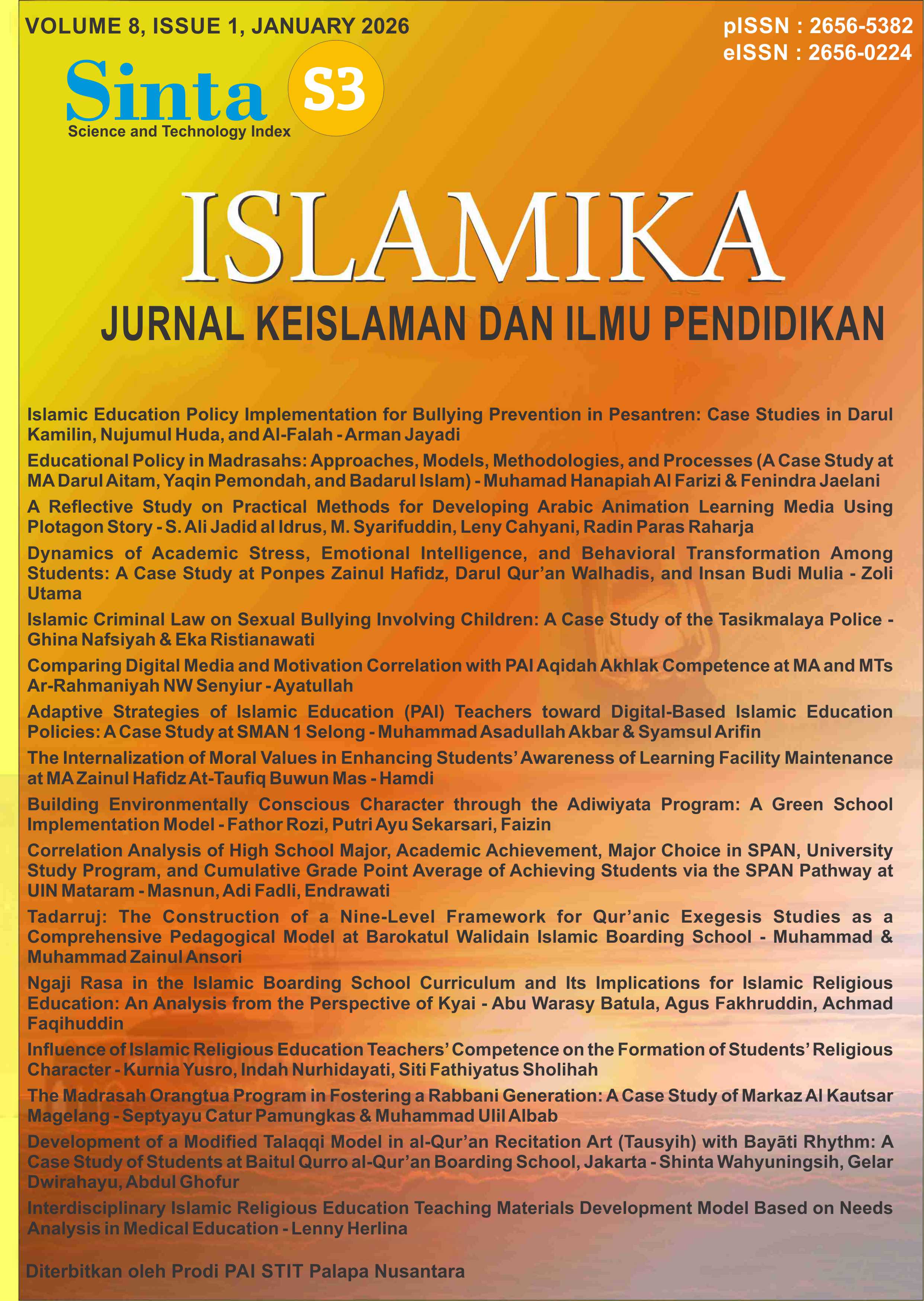
Adaptive Strategies of Islamic Education (PAI) Teachers toward Digital-Based Islamic Education Policies: A Case Study at SMAN 1 Selong

Article Sidebar
 Digital Object Identifier:
10.36088/islamika.v8i1.6020
Digital Object Identifier:
10.36088/islamika.v8i1.6020
 Viewed : 377 times
 Downloaded : 339 times
















Main Article Content
1 UIN Mataram, Indonesia, 2 UIN Mataram, Indonesia
Abstract
This study is motivated by the limited empirical research on how Islamic Religious Education (PAI) teachers adapt to digital-based education policies amid the growing influence of digital transformation in public secondary schools. It aims to examine PAI teachers’ adaptive strategies, the enabling and constraining conditions that shape these strategies, and their implications for learning effectiveness at SMAN 1 Selong. Using a qualitative single-case study design, the research involved 15 purposively selected participants, including PAI teachers, students, and school leaders. Data were collected through semi-structured interviews, classroom observations, and document analysis, and were analyzed thematically to identify patterns of teacher adaptation, policy enactment, and learning outcomes. The findings reveal that PAI teachers exhibit adaptive capacity through the integration of pedagogical flexibility, functional use of digital technology, and sustained spiritual intentionality. Teacher adaptation is driven by intrinsic motivation, institutional support, and peer collaboration, while it is constrained by unequal student access to technology, varying levels of digital competence, and increased administrative demands. Importantly, digital-based instruction does not weaken religious values; rather, when implemented contextually, it supports cognitive engagement, affective development, and spiritual learning objectives. The study concludes that digital adaptation in PAI is a value-mediated and context-sensitive process rather than a purely technical response to policy mandates, and it contributes to theoretical discussions on teacher adaptation in religious education while offering practical implications for policymakers and school leaders in designing digital policies and professional development that remain pedagogically effective and spiritually grounded.
Citation Metrics:


Downloads
Article Details

Authors retain copyright and grant the journal right of first publication with the work simultaneously licensed under a Creative Commons Attribution-NonCommercial-ShareAlike 4.0 International License that allows others to share the work with an acknowledgement of the work's authorship and initial publication in this journal.
Find the perfect home for your research! If this journal isn't the right fit, don't worry—we offer a wide range of journals covering diverse fields of study. Explore our other journals to discover the ideal platform for your work and maximize its impact. Browse now and take the next step in publishing your research:
| HOME | Yasin | AlSys | Anwarul | Masaliq | Arzusin | Tsaqofah | Ahkam | AlDyas | Mikailalsys | Edumalsys | Alsystech | AJSTEA | AJECEE | AJISD | IJHESS | IJEMT | IJECS | MJMS | MJAEI | AMJSAI | AJBMBR | AJSTM | AJCMPR | AJMSPHR | KIJST | KIJEIT | KIJAHRS |