
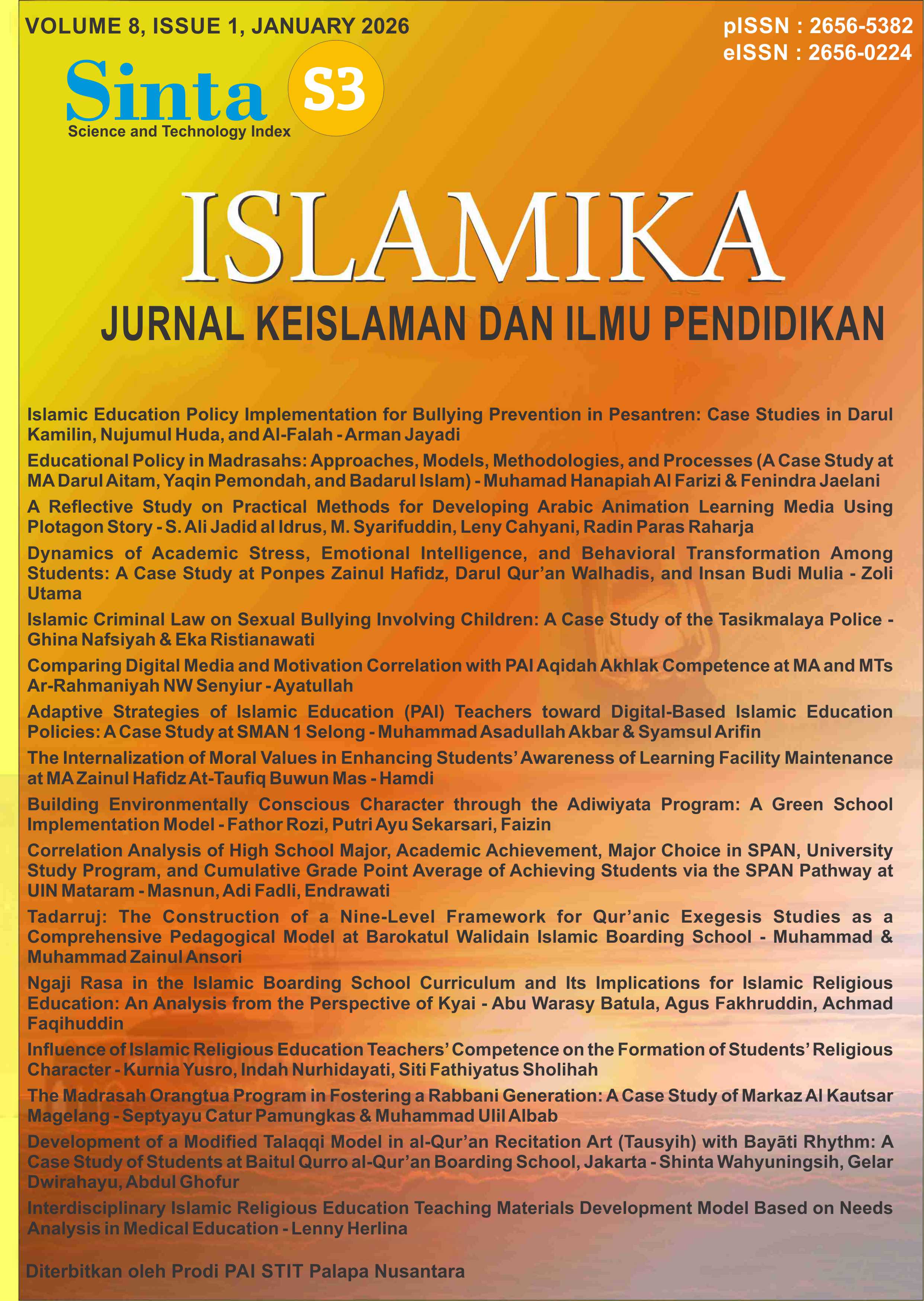
Building Environmentally Conscious Character through the Adiwiyata Program: A Green School Implementation Model

Article Sidebar
 Digital Object Identifier:
10.36088/islamika.v8i1.6018
Digital Object Identifier:
10.36088/islamika.v8i1.6018
 Viewed : 479 times
 Downloaded : 427 times
















Main Article Content
1 Universitas Nurul Jadid, Indonesia, 2 Universitas Nurul Jadid, Indonesia, 3 Universitas Nurul Jadid, Indonesia
Abstract
Increasingly complex environmental problems, such as students’ low awareness and concern for the cleanliness and sustainability of the school environment, indicate that environmentally based character education has not been optimally internalized in educational practice, as reflected in behaviors such as littering, poor classroom maintenance, and limited participation in environmental activities. This study aims to analyze the implementation of the Adiwiyata Program at SMA Negeri 1 Gending as an effort to build environmental awareness among students. Using a qualitative case study approach, data were collected through interviews with the principal, vice principal, teachers, and students; direct observation of student behavior across various areas of the school; and documentation in the form of activity reports, school policies, and program archives, and were analyzed descriptively. The results indicate that the Adiwiyata Program has been comprehensively implemented in learning, student activities, and school management, with the integration of environmental values into lesson materials, student council activities, and school policies encouraging observable changes in student behavior, such as properly disposing of trash, maintaining classroom cleanliness, caring for plants, using reusable food containers, and reminding peers to keep the school clean. Documentation further highlights supporting factors, including the commitment of school principals, the Adiwiyata organizational structure, and parental support, alongside obstacles such as budget constraints, low participation among some teachers, and limited ongoing training. The findings demonstrate that the synergy of policies, learning, school culture, and the participation of all school elements critically influences the success of environmental character building. The implications of this research underscore the importance of institutional strengthening, program sustainability, and the integration of environmental education into school policies and the national curriculum to cultivate ecological character in the next generation.
Citation Metrics:


Downloads
Article Details

Authors retain copyright and grant the journal right of first publication with the work simultaneously licensed under a Creative Commons Attribution-NonCommercial-ShareAlike 4.0 International License that allows others to share the work with an acknowledgement of the work's authorship and initial publication in this journal.
Find the perfect home for your research! If this journal isn't the right fit, don't worry—we offer a wide range of journals covering diverse fields of study. Explore our other journals to discover the ideal platform for your work and maximize its impact. Browse now and take the next step in publishing your research:
| HOME | Yasin | AlSys | Anwarul | Masaliq | Arzusin | Tsaqofah | Ahkam | AlDyas | Mikailalsys | Edumalsys | Alsystech | AJSTEA | AJECEE | AJISD | IJHESS | IJEMT | IJECS | MJMS | MJAEI | AMJSAI | AJBMBR | AJSTM | AJCMPR | AJMSPHR | KIJST | KIJEIT | KIJAHRS |