
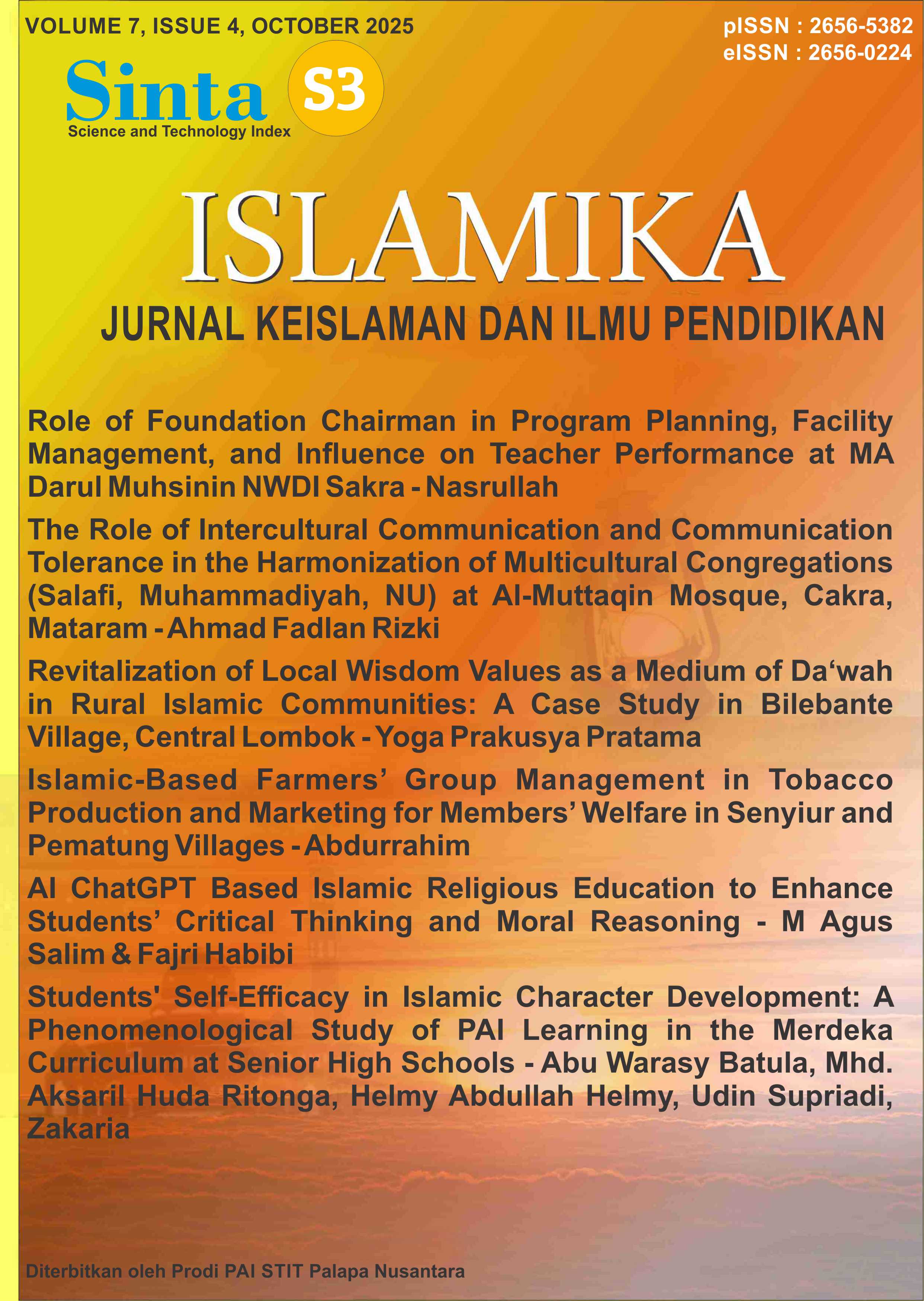
The Role of Intercultural Communication and Communication Tolerance in the Harmonization of Multicultural Congregations (Salafi, Muhammadiyah, NU) at Al-Muttaqin Mosque, Cakra, Mataram

Article Sidebar
 Digital Object Identifier:
10.36088/islamika.v7i4.5910
Digital Object Identifier:
10.36088/islamika.v7i4.5910
 Viewed : 446 times
 Downloaded : 391 times
















Main Article Content
1 UIN Mataram. Indonesia
Abstract
This study addresses the limited scholarly attention to intercultural communication and tolerance within intra-Islamic contexts, despite their crucial role in sustaining social harmony. While most existing literature focuses on interfaith dialogue, fewer studies examine how diverse Islamic groups, such as Salafi, Muhammadiyah, and Nahdlatul Ulama (NU) negotiate coexistence in shared religious spaces. Focusing on Al-Muttaqin Mosque, Cakra, Mataram, this research aims to (1) assess how intercultural communication contributes to harmony, (2) identify key factors shaping tolerance, and (3) analyze how tolerance fosters social cohesion. A qualitative descriptive design was employed, using purposive sampling of active congregants and mosque administrators. Data were collected through semi-structured interviews, direct observation, and document review, and analyzed thematically to identify communication patterns. The findings reveal that intercultural communication bridges doctrinal differences through respectful dialogue, religious expressions, and non-verbal practices such as greetings, handshakes, and shared meals. Collaborative activities, including Qur’anic study circles, charity programs, and mosque renovations further reinforced cooperation beyond group boundaries. Tolerance was shaped by neutral leadership policies, historical experiences of coexistence, and cultural traditions such as gotong royong, which collectively fostered harmony by mitigating doctrinal tensions, strengthening trust, and cultivating shared ownership of mosque life. The study concludes that effective communication and tolerance mechanisms transform intra-faith diversity from a source of potential conflict into a foundation for unity. Theoretically, it extends intercultural communication frameworks into intra-Islamic settings, while practically offering guidance for mosque administrators and religious leaders to promote inclusivity through balanced programming and collaborative initiatives.
Citation Metrics:


Downloads
Article Details

Authors retain copyright and grant the journal right of first publication with the work simultaneously licensed under a Creative Commons Attribution-NonCommercial-ShareAlike 4.0 International License that allows others to share the work with an acknowledgement of the work's authorship and initial publication in this journal.
Find the perfect home for your research! If this journal isn't the right fit, don't worry—we offer a wide range of journals covering diverse fields of study. Explore our other journals to discover the ideal platform for your work and maximize its impact. Browse now and take the next step in publishing your research:
| HOME | Yasin | AlSys | Anwarul | Masaliq | Arzusin | Tsaqofah | Ahkam | AlDyas | Mikailalsys | Edumalsys | Alsystech | AJSTEA | AJECEE | AJISD | IJHESS | IJEMT | IJECS | MJMS | MJAEI | AMJSAI | AJBMBR | AJSTM | AJCMPR | AJMSPHR | KIJST | KIJEIT | KIJAHRS |